
The Adaptive CX Guide
If you're new to Adaptive CX, start here. Pick the right moment, agree what's true, design the behaviour, govern it properly, then prove it works.
What is Adaptive Customer Experience?
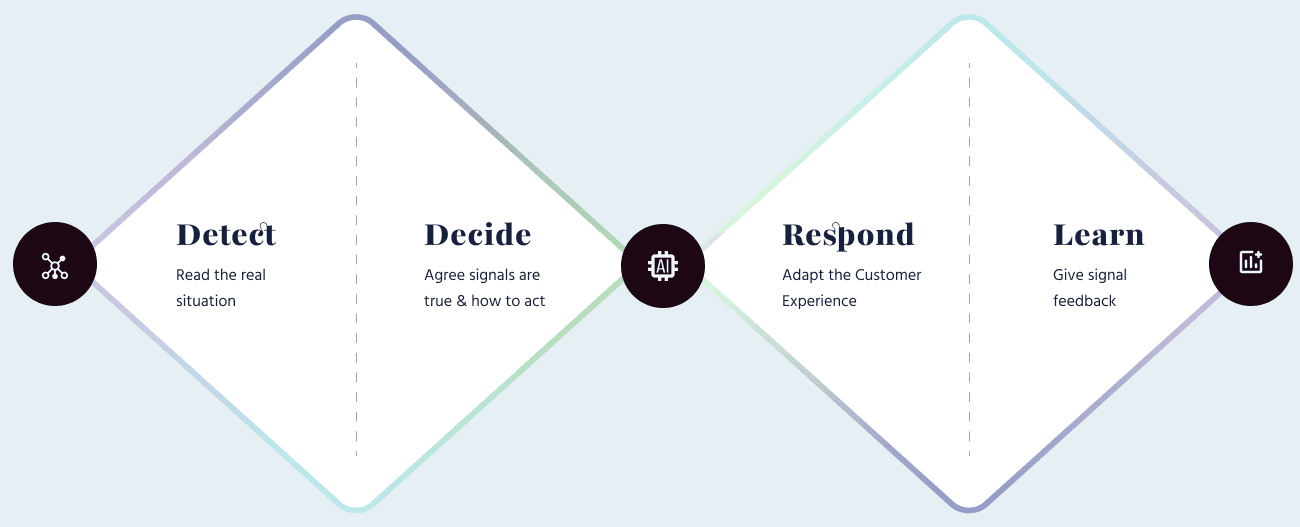
The Adaptive CX Model is a continuous loop that turns static journeys into experiences that respond to what is actually happening.
Four connected pillars — Detect, Decide, Respond, Learn — that give teams a shared language and operating model for designing services that adapt to real customer signals, not assumed ones.
Why businesses invest in Adaptive CX
Most AI in CX fails not because the technology is wrong, but because it acts on assumed journeys rather than real signals. Adaptive CX changes that — it reads what is actually happening for each customer, decides what is true enough to act on, and responds at the right level of autonomy. Then it learns. Every resolved moment feeds back into the system, tightening signal quality and unlocking smarter responses over time.
Learn the full framework →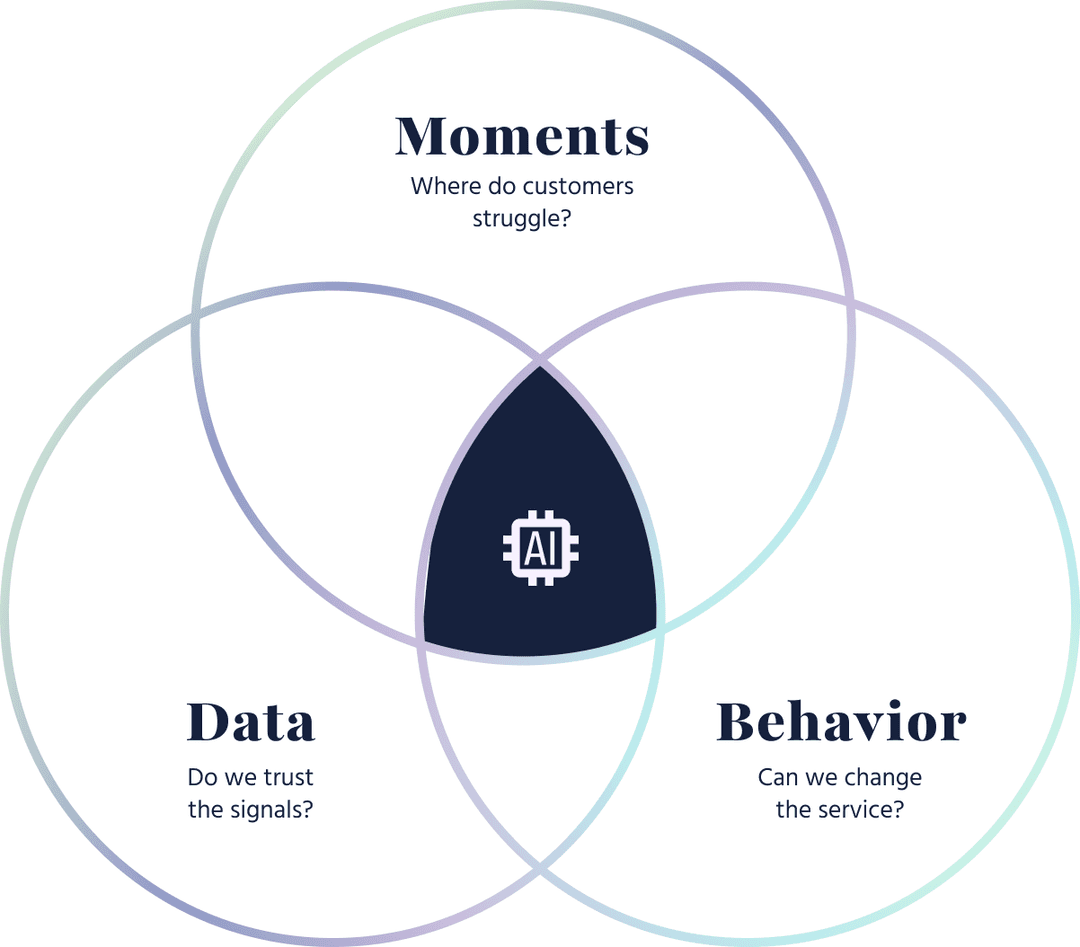
Adaptive CX design
Adaptive CX sits at the intersection of three critical dimensions. Understanding where your customers struggle is just the start — you need real-time data signals to trust, and the operational capability to actually change the service in that moment.
Moments
Where do your customers struggle or have the most potential to be delighted?
Data
Do you have signals reliable enough to trust and act on in real time?
Behavior
Can your service actually change quickly enough to respond to what's happening?
Six steps to your first adaptive moment
From identifying the moment to measuring what works.
Pick the moment
Identify the high-value customer moment where adaptive service will make the biggest difference. Start with a moment where customers get stuck, outcomes matter, or agents repeat the same triage.
Get the Adaptive Moments DeckDetect signals
Define which real-time data points tell you what is actually happening for this customer, right now. Focus on signals you can trust and that directly inform your service decisions.
Learn about signal designCheck truth
Set confidence thresholds and evidence standards — what do you need to know before you act? A truth contract defines what the service treats as reliable enough to respond to.
Explore truth contractsDecide behaviour
Map the right level of AI autonomy, channel, message, fallback, and stop rules for this moment. A behaviour spec covers triggers, context, response rules, escalation, and governance.
Learn about Behaviour SpecsActivate change
Build and deploy the adaptive response using your existing platforms and technology. Start with Assist or Advise behaviour and only move toward automation when truth is reliable.
See the platform acceleratorsProve & learn
Measure outcomes, feed learnings back into signal quality and behaviour calibration. Every resolved moment improves the system, progressively unlocking higher autonomy over time.
Discover measurement patternsWhat Could Change in Your Service
These are real customer moments in services like yours. See how adaptive design changes the outcome.
Delivery Disruption Moment
A carrier reports an unexpected delay on a time-sensitive order
Delay Reported
Carrier flags 48-hour delivery delay
Signal Detected
Gift order, birthday delivery now impossible
Adaptive Response
Proactive outreach with options: refund, reroute, alternative
Outcome
Customer chooses store pickup, satisfaction maintained
Delay Reported
Carrier flags 48-hour delivery delay
Signal Detected
Gift order, birthday delivery now impossible
Adaptive Response
Proactive outreach with options: refund, reroute, alternative
Outcome
Customer chooses store pickup, satisfaction maintained
Churn Risk Moment
A long-standing customer shows signs of leaving
Cancellation Attempt
Customer visits the cancellation page
Signal Detected
5-year tenure, recent service issue, high LTV
Adaptive Response
Route to retention specialist with full context
Outcome
Issue resolved, loyalty offer accepted
Cancellation Attempt
Customer visits the cancellation page
Signal Detected
5-year tenure, recent service issue, high LTV
Adaptive Response
Route to retention specialist with full context
Outcome
Issue resolved, loyalty offer accepted
Payment Failure Moment
A high-value customer's payment fails at checkout
Payment Fails
Customer's card is declined at checkout
Signal Detected
High-value customer, first failure in 3 years
Adaptive Response
Auto-retry with alternative, proactive SMS sent
Outcome
Payment recovered, no support contact needed
Payment Fails
Customer's card is declined at checkout
Signal Detected
High-value customer, first failure in 3 years
Adaptive Response
Auto-retry with alternative, proactive SMS sent
Outcome
Payment recovered, no support contact needed
Support Escalation Moment
A frustrated customer contacts support repeatedly
Repeat Contact
Third support contact this week
Signal Detected
Repeat contact, frustration signals, previous failed attempts
Adaptive Response
Skip standard script, escalate immediately with context
Outcome
First-contact resolution, feedback captured
Repeat Contact
Third support contact this week
Signal Detected
Repeat contact, frustration signals, previous failed attempts
Adaptive Response
Skip standard script, escalate immediately with context
Outcome
First-contact resolution, feedback captured
80% fail to move beyond pilot stage — IHL Group, 2024
How can we help?
Answer 3 quick questions. We'll show you which service fits your situation.
After the quiz, you'll see:
- A recommended starting point based on your situation
- What you'll receive from that service
- What it enables you to do next
Prefer to talk?
Send us a message and we'll get back to you within 24 hours.