
What is Adaptive Customer Experience?
The practice of designing customer experience journeys that sense changing conditions, apply contextual judgement, and respond appropriately with clear boundaries for when AI should act and when it should defer.
Adaptive Customer Experience (Adaptive CX) is a method of designing customer journeys that respond to real-time conditions — using customer signals, decision logic, and dynamic responses to adapt the experience as situations change.
Rather than following fixed paths, adaptive CX services detect what is actually happening, agree on what is true enough to act on, respond with the appropriate behaviour, and learn from outcomes to improve over time.
This is not about replacing technology. Most organisations already have the activation surfaces they need. The gap is service design: defining what AI should sense, decide, do, and learn at each moment.
What is Adaptive Customer Experience?
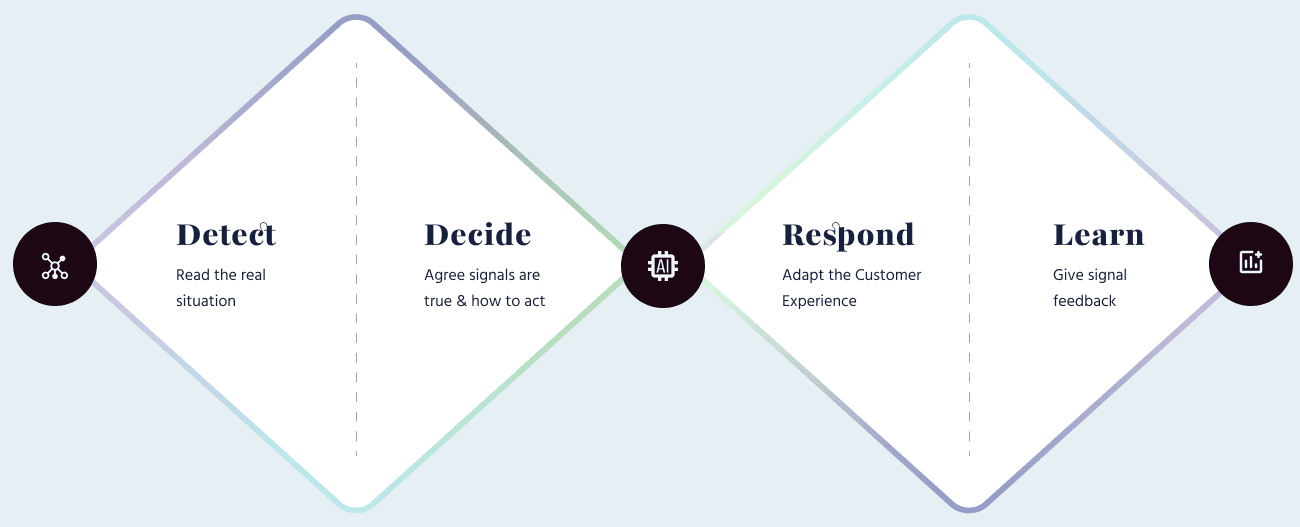
The Adaptive CX Model is a continuous loop that turns static journeys into experiences that respond to what is actually happening.
Four connected pillars — Detect, Decide, Respond, Learn — that give teams a shared language and operating model for designing services that adapt to real customer signals, not assumed ones.
Why businesses invest in Adaptive CX
Most AI in CX fails not because the technology is wrong, but because it acts on assumed journeys rather than real signals. Adaptive CX changes that — it reads what is actually happening for each customer, decides what is true enough to act on, and responds at the right level of autonomy. Then it learns. Every resolved moment feeds back into the system, tightening signal quality and unlocking smarter responses over time.
Learn the full framework →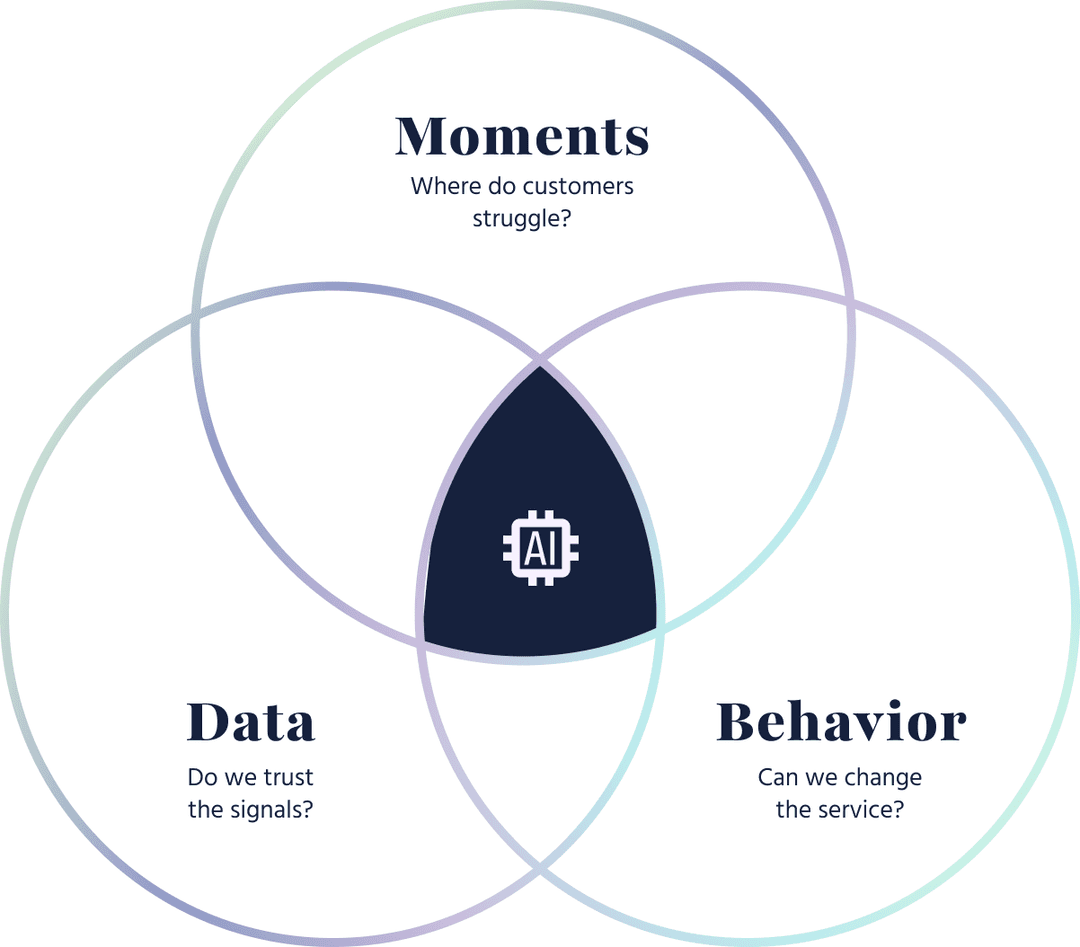
Adaptive CX design
Adaptive CX sits at the intersection of three critical dimensions. Understanding where your customers struggle is just the start — you need real-time data signals to trust, and the operational capability to actually change the service in that moment.
Moments
Where do your customers struggle or have the most potential to be delighted?
Data
Do you have signals reliable enough to trust and act on in real time?
Behavior
Can your service actually change quickly enough to respond to what's happening?
How Adaptive CX works
Every adaptive customer experience moment follows the same four-step model. Each step has clear design requirements that determine whether the service can respond safely and with the right level of autonomy.
Detect: identifying customer signals and operational changes
The service collects real-time signals about what is happening — customer state, operational state, or risk. Signals are not just data points; they carry freshness and confidence that determine whether they are reliable enough to act on.
Examples: delivery disruption status, payment failure, cancellation intent, bill amount delta.
Decide: interpreting context and determining the right response
A truth contract defines what the service treats as true enough to act on — including minimum evidence thresholds, confidence bands, and whether to ask the customer or assume from existing signals. This is where AI decision-making is governed.
The truth contract is the boundary between confident action and safe deferral.
Respond: adapting content, journeys, and service behaviour
A behaviour spec defines what the service does in the moment — which channel, at what autonomy level (inform, assist, route, orchestrate, or act), with what fallbacks and stop rules. The response is proportional to the confidence of the truth.
Higher autonomy requires stronger signals. Weak signals force conservative responses.
Learn: improving outcomes through continuous feedback
After each adaptive moment, the service measures whether the response worked — did the customer get the right outcome? Were escalations reduced? Did conversion improve? These results feed back into signal quality and behaviour spec refinement.
This is what separates adaptive CX from a one-time improvement project.
Detect → Decide → Respond → Learn is the repeating cycle that makes a customer experience genuinely adaptive. Each pass improves signal quality, tightens truth contracts, and unlocks higher levels of AI autonomy safely.
Why traditional journey mapping fails
Traditional CX maps fixed journeys and assumes every customer follows the same path. Adaptive CX acknowledges that conditions change — and designs services that can respond.
Journey maps are useful for understanding the intended path. They fail when a delivery is disrupted, a payment bounces, or a customer is mid-cancellation. At that point the map has no answer — and neither does the AI built on top of it.
Traditional CX asks
"What is the perfect journey?"
Adaptive CX asks
"What moments matter most, and how should we respond when conditions change?"
| Type | Static CX | Adaptive CX |
|---|---|---|
| Inputs | Surveys, personas, assumed preferences | Real-time signals, observed behaviour, system-of-record truth |
| Decision Logic | Fixed rules applied uniformly | Contextual response within defined boundaries |
| Cross-Channel | Separate journeys per channel | Continuous context across touchpoints |
| Governance | Review before launch, then hands-off | Continuous monitoring with escalation thresholds |
| Measurement | Aggregate satisfaction scores | Moment-level outcome tracking with feedback loops |
Adaptive moments in action
Real-world scenarios showing how Detect → Decide → Respond → Learn applies across common service moments.
Delivery delay
Static CX: Customer waits, contacts support, gets a generic tracking link.
Adaptive CX: The service detects the disruption signal from the carrier feed (Detect), confirms confidence is high enough to notify (Decide), sends a proactive SMS with revised ETA and a self-service reschedule option (Respond), and measures whether contacts to support decreased (Learn).
Onboarding issue
Static CX: New customer stalls on step three, drops off, no intervention.
Adaptive CX: The service detects inactivity at a known friction point (Detect), confirms the customer is within the first 72 hours and has not completed onboarding (Decide), sends a targeted message with the specific step they stalled on and an offer of live chat support (Respond), and measures completion rate against the baseline (Learn).
Payment failure
Static CX: Generic failed payment email, customer calls support confused about account status.
Adaptive CX: The payment failure signal triggers an immediate truth check — is this a card expiry, insufficient funds, or a bank block? (Decide). Each route has a distinct response: expired card gets a one-tap update link, insufficient funds gets a payment plan option, bank block gets a call-me-back (Respond). Resolution rate and support contact rate feed back into future routing logic (Learn).
Benefits of Adaptive CX
Organisations shifting from static to adaptive CX see measurable improvements across cost, experience, and revenue.
Reduce customer service costs
Proactive, context-aware responses reduce inbound contacts. When the service responds before the customer has to ask, support volumes fall — without reducing service quality.
Improve customer experience with AI
AI that responds to real conditions rather than assumed journeys produces fewer wrong answers and more relevant interactions. Customers get what they need faster, with less friction.
Increase conversion and retention
Adaptive moments at high-value friction points — onboarding stalls, payment failures, cancellation intent — recover revenue that static journeys would lose. The right response at the right moment changes outcomes.
Signals, Truth, and Behaviour
The three foundations of adaptive CX.
Signal
A piece of evidence about what is true right now—customer state, operational state, or risk—with freshness and confidence attached. Signals aren't just data points. They're claims about reality that expire and degrade over time.
Examples of signals:
- Delivery disruption status (from ops feed, fresh within 5 minutes)
- Bill amount delta from previous period (from billing system, confident and fresh)
- Customer cancellation intent (from explicit action, high confidence, expires after session)
- Payment failure indicator (from payment gateway, immediate confidence, requires retry window)
Truth Contract (X maturity)
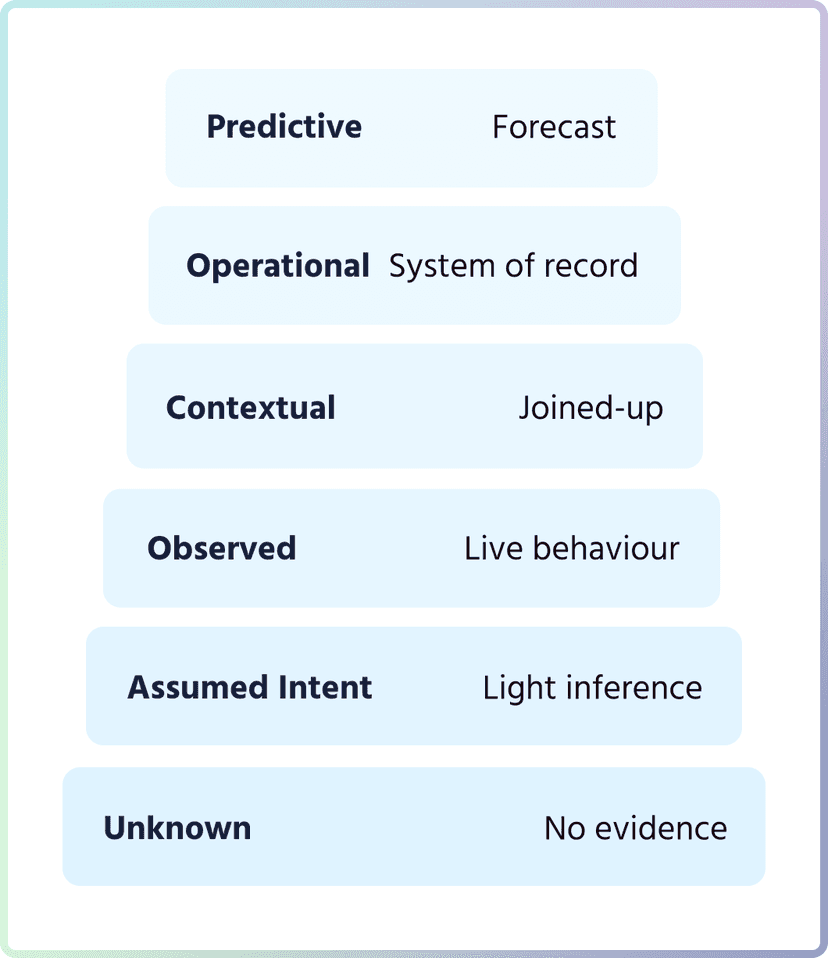
The definition of what the service will treat as "true enough to act on." This includes minimum viable evidence, confidence bands (high/medium/low), freshness and expiry rules, and explicit ask-vs-assume guidelines. The truth contract is what passes through the Truth gate.
Behaviour Spec (Y maturity)
The definition of what the service should do in a moment, including Y level (inform/assist/route/orchestrate/act), channel-specific behaviors, autonomy boundaries, stop rules, fallbacks, and escalation paths. The behaviour spec is what passes through the Safety gate.
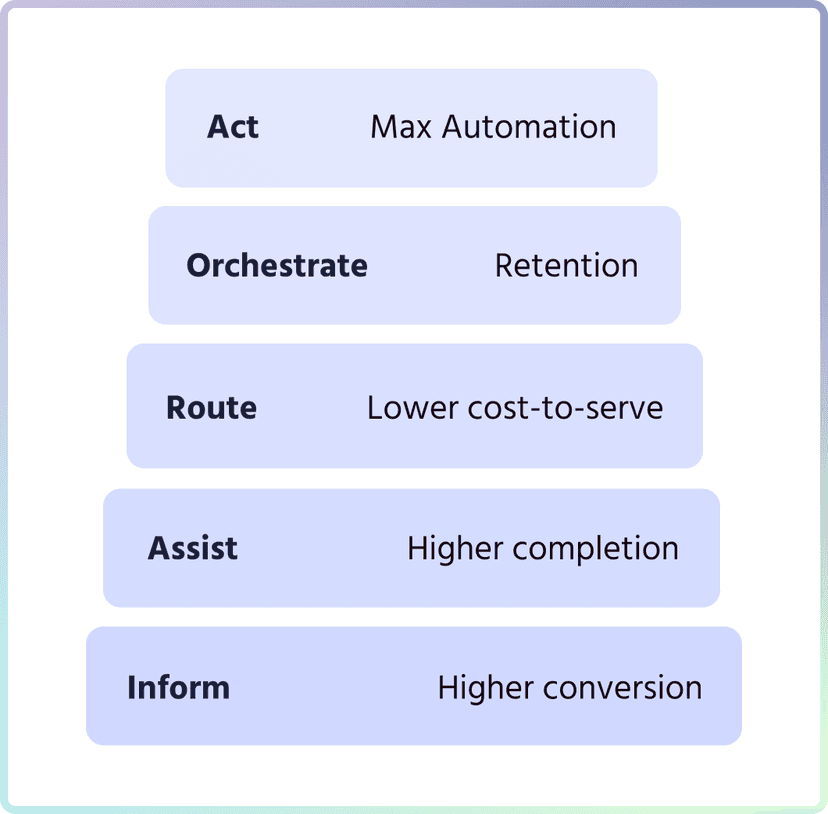
The relationship: Signals feed the truth contract, which unlocks behavior that's safe to execute. Weak signals force conservative behavior. Strong signals enable higher autonomy and value.
The critical insight is that you don't need a platform rebuild to start. Most organizations already have activation surfaces they're not fully utilizing. Comms templates can deliver proactive disruption updates. Routing rules can send customers to the right team with context. Agent scripts can provide consistent guidance based on moment detection.
Activation Readiness is the practice of mapping what surfaces exist, who owns them, what lead times apply, and what changes are blocked. This prevents "AI theatre"—impressive strategy decks that can't ship because nobody can actually change anything.
When you discover activation is blocked, you have three options:
- •Use low-tech levers first — Ship value through comms, routing, and scripts while platform work happens
- •Build activation capability — Invest in unlocking faster surfaces (e.g., content management, rules engines)
- •Defer high-Y moments — Choose moments that match your current activation capability
The worst mistake is designing Y5 (Act) moments when your activation reality is "we can change email templates every two weeks." Match ambition to capability, then systematically unlock higher surfaces.
The CX Maturity Model
This framework is the control plane for adaptive CX. It governs what you build, when you build it, and how you scale safely. At its core are two dimensions that determine both capability and value.
The horizontal axis represents knowledge maturity, labeled X. It measures how reliable your truth is, progressing from X0 (no signals, only guesses) through X5 (predictive signals with drift monitoring). The vertical axis represents adaptation maturity, labeled Y. It measures how dynamically your service responds, progressing from Y1 (inform with static content) through Y5 (act by executing changes on behalf of customers).
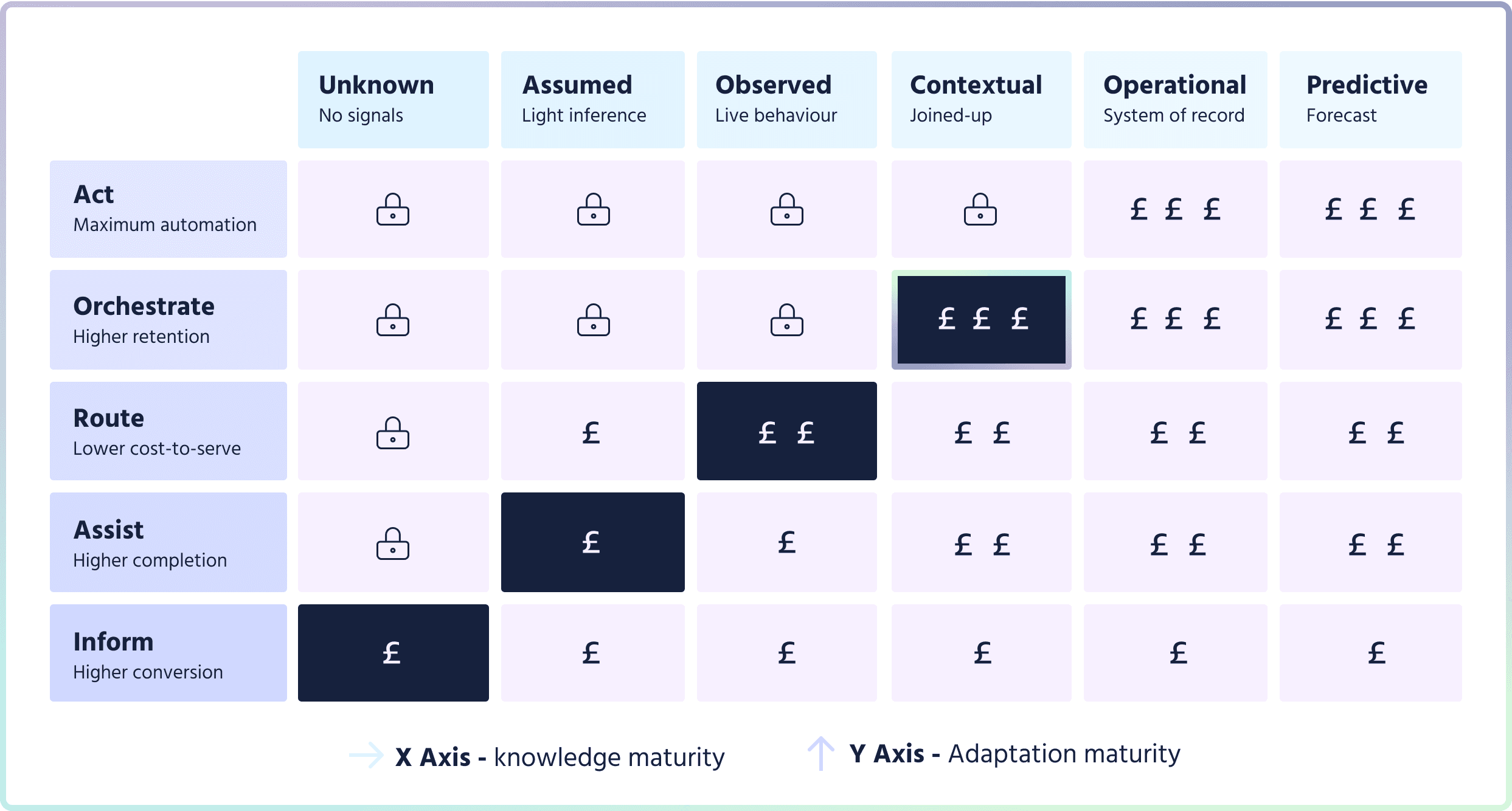
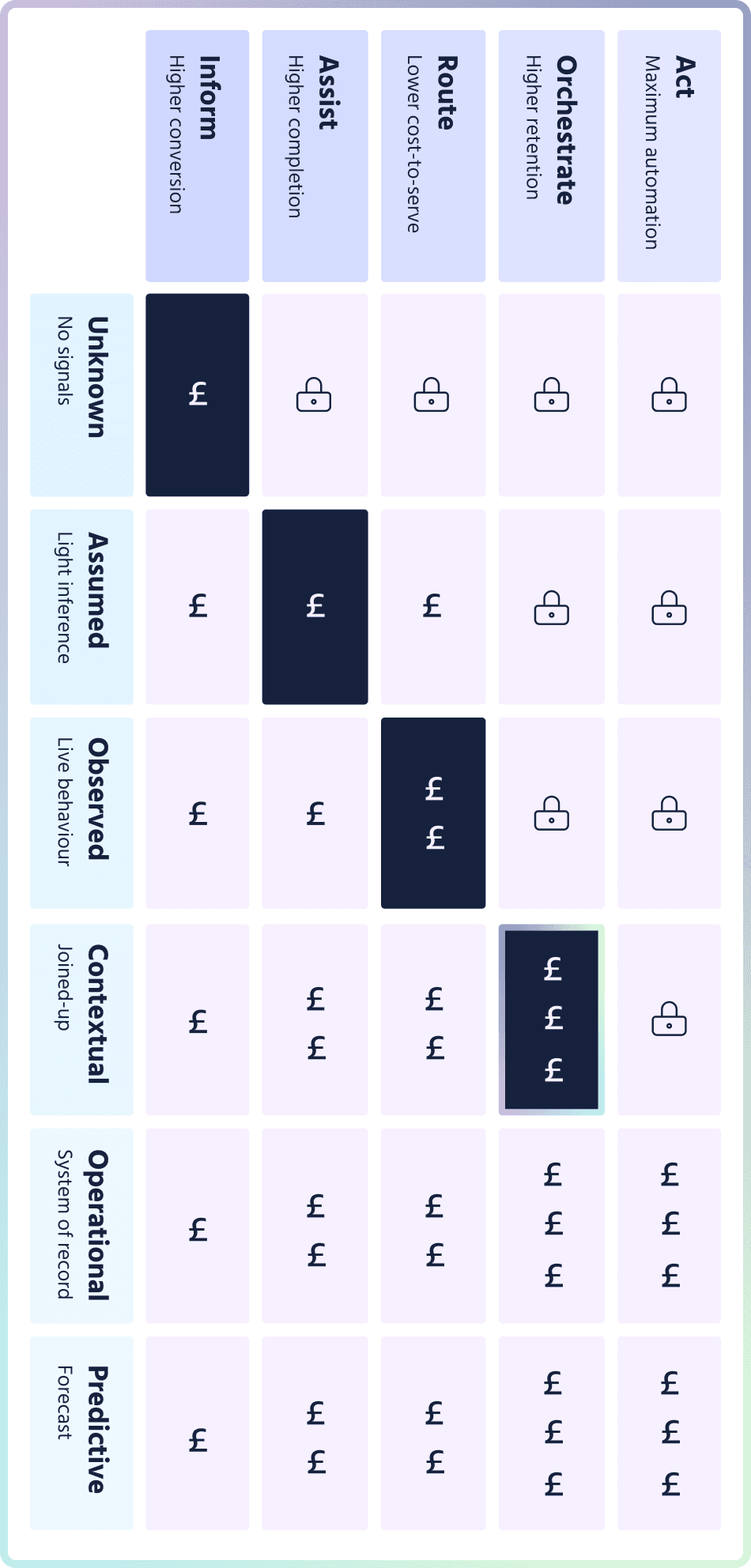
The relationship between these dimensions follows a diagonal rule. Higher Y capabilities require stronger X foundations. You can't safely route customers based on behavioral signals alone (Y3) if your only signals are form submissions (X1). You can't automatically reschedule deliveries (Y5) if you're working with estimated ETAs rather than operational truth from systems of record (X4).
Most organizations begin at X1-X2 with Y1-Y2. They use declared preferences and observed behaviors to inform customers and assist with simple tasks. This is achievable and low-risk, but also low-value. The high-value opportunities emerge at X3-X4 with Y3-Y4, where contextual and operational truth enables intelligent routing and cross-channel orchestration.
The grid makes one thing clear: you must build up the X-axis before you can safely move right on the Y-axis. Organizations that jump to Y5 (act) while still at X2 (observed) are building confident wrongness at scale. They're automating actions based on behavioral guesses rather than operational truth.
Understanding where you are on this grid determines your investment priorities. If you're at X1, invest in signal quality and operational truth before attempting orchestration. If you're at X4 but only Y2, you have dormant value waiting to be unlocked through higher adaptation.
The Four Gates
Before any moment increases its autonomy level, it must pass four governance gates. These are the controls that make safe scaling possible.
Truth
Is the signal reliable enough to act on?
Validates data freshness, source reliability, and confidence levels before decisions are made.
Prevents: Acting on stale or unverified data
Safety
Can this fail without harming customers?
Ensures fallback paths exist and failure modes are understood before automation scales.
Prevents: Automated harm at scale
Recovery
If it fails, how do we detect and recover?
Requires observable outcomes and early warning signals before expanding scope.
Prevents: Scaling before proving value
Audit
Can we explain what happened and why?
Confirms regulatory requirements are met and decisions can be explained on request.
Prevents: Regulatory risk
These are not bureaucratic checkpoints. They are the controls that let you scale safely and stop quickly when things go wrong.
Ready to see how it works for you?
Get in touch to discuss how adaptive CX applies to your organisation.
Get in touchFrequently asked questions
These are the most common questions leaders ask when exploring AI in customer experience.