See the moment. Design the response.
Kairos is the design and governance consultancy for AI in customer experience. We help teams close the gap between AI potential and AI delivery — designing what AI should do before anyone starts building.
Most customer journeys are too static
Static experiences leak value. Most customer journeys are designed for the ideal path. Real customers don't follow it.
For years, CX has been shaped around journeys, flows, and ideal paths — but most customers don't experience services that neatly. They hit messy moments where something changes, expectations wobble, and the experience either helps or starts leaking value. When that happens, static journeys create friction, missed opportunities, and avoidable support demand.
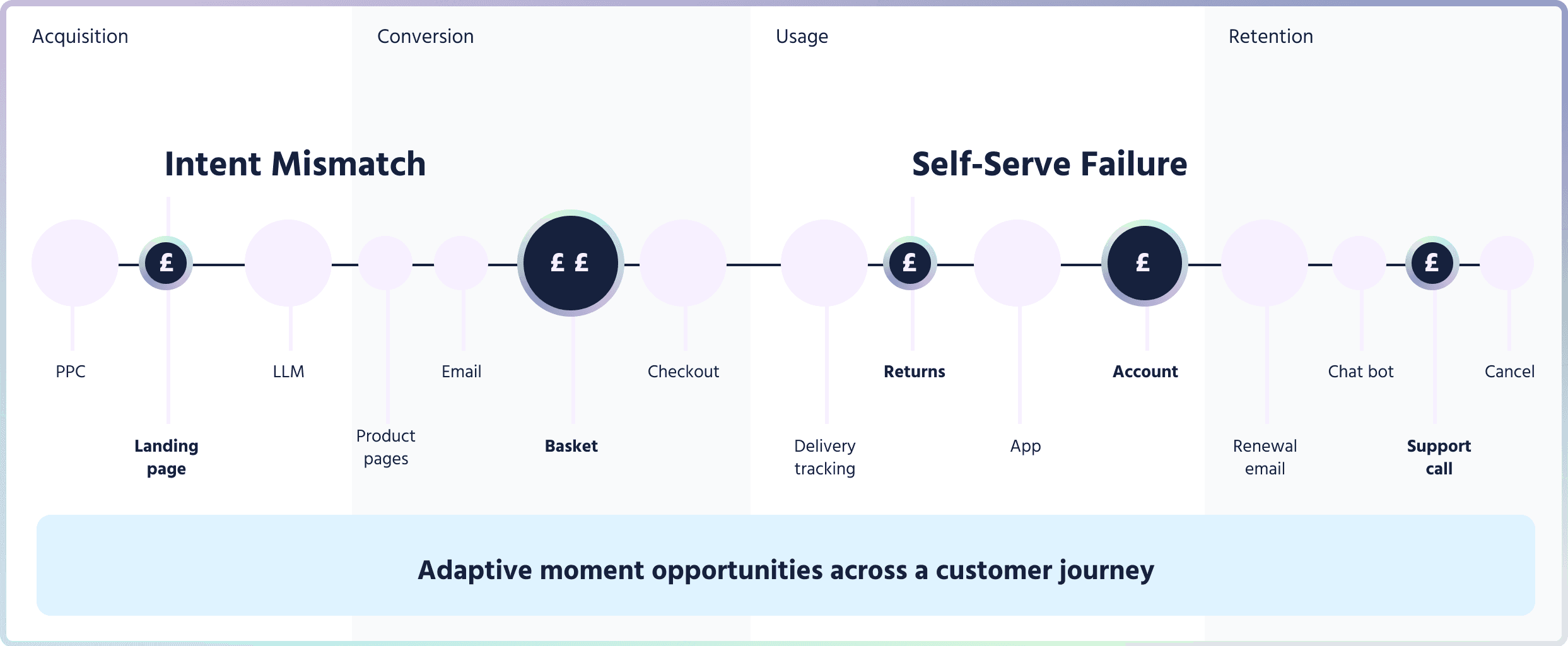
What is Adaptive Customer Experience?
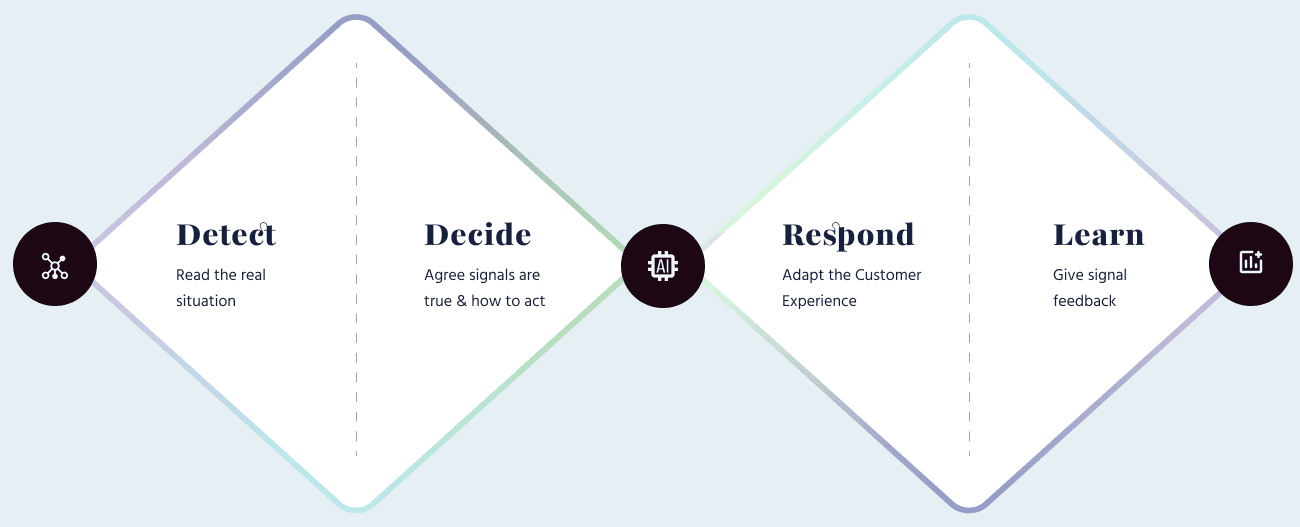
The Adaptive CX Model is a continuous loop that turns static journeys into experiences that respond to what is actually happening.
Four connected pillars — Detect, Decide, Respond, Learn — that give teams a shared language and operating model for designing services that adapt to real customer signals, not assumed ones.
Why businesses invest in Adaptive CX
Adaptive CX improves the moments that drive trust, conversion, efficiency and retention.
Most AI in CX fails not because the technology is wrong, but because it acts on assumed journeys rather than real signals. Adaptive CX changes that — it reads what is actually happening for each customer, decides what is true enough to act on, and responds at the right level of autonomy. Then it learns. Every resolved moment feeds back into the system, tightening signal quality and unlocking smarter responses over time.
Learn the full framework →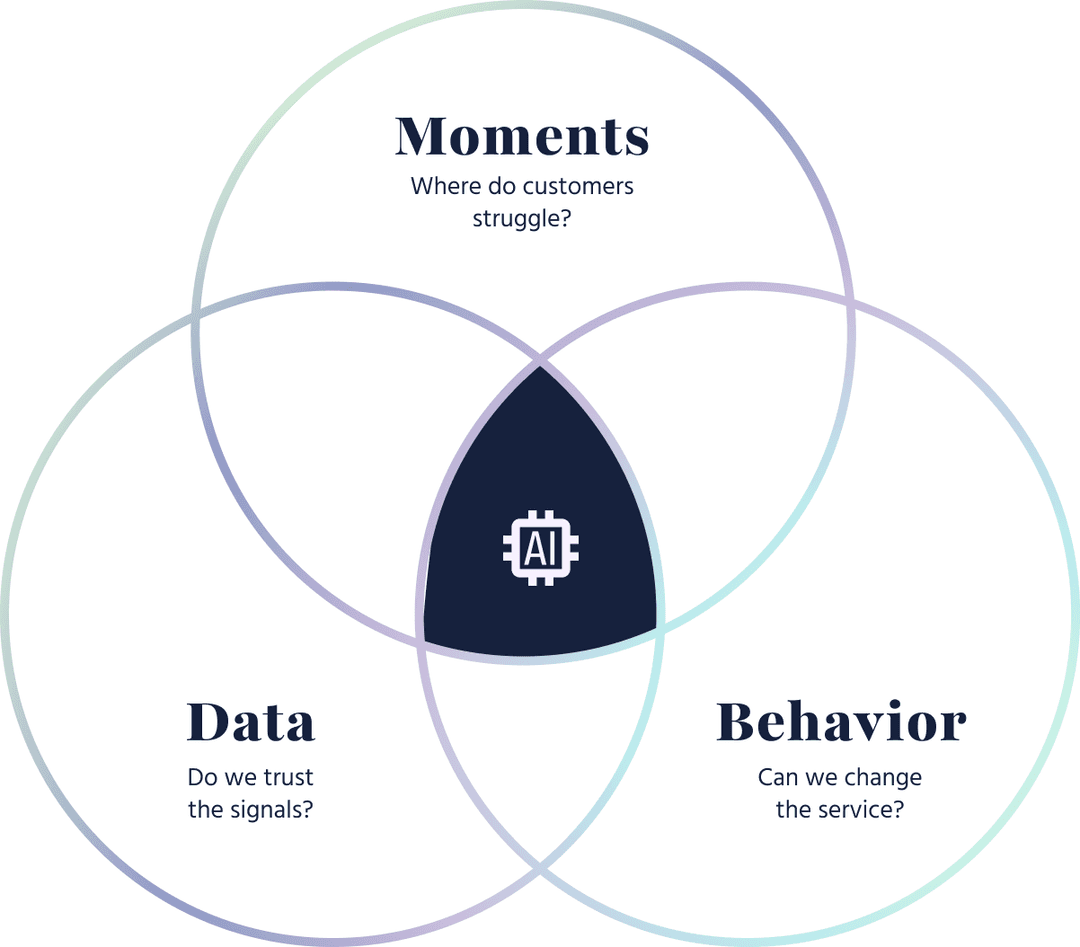
Adaptive CX design
Adaptive CX sits at the intersection of three critical dimensions. Understanding where your customers struggle is just the start — you need real-time data signals to trust, and the operational capability to actually change the service in that moment.
Moments
Where do your customers struggle or have the most potential to be delighted?
Data
Do you have signals reliable enough to trust and act on in real time?
Behavior
Can your service actually change quickly enough to respond to what's happening?
Adaptive CX done well
The real differentiator is rarely the technology. It is whether a service has enough truth to recognise that the moment has changed — and enough designed behaviour to respond usefully when it does.
Starling Bank
Spending Intelligence lets customers ask natural-language questions about their finances and get answers based on live account activity. Scam Intelligence surfaces risk cues before a customer completes a risky transaction. The service responds differently depending on the customer's immediate need — clarity in one moment, protection in another.
Read the maturity analysis →Adobe Journey Optimizer
Built around real-time profiles and in-the-moment orchestration. The system moves beyond fixed campaign schedules to respond to what customers are doing across channels now. A strong example of a common maturity pattern: stronger signals than service behaviour — the infrastructure is there, but the experience only becomes truly adaptive when teams define how the service should respond.
Read the maturity analysis →Travel: recovery moments
Airlines and booking platforms have access to real-time operational data — gate changes, delay codes, alternative routing — well before the customer is standing at the departure board. At a lower rung, a delayed flight triggers an SMS. At a higher rung, the service proactively surfaces rebooking options or meal vouchers before the customer asks. The difference is not the technology.
Read the maturity analysis →Activate through the tools you already have
You don't need to replace your stack. Adaptive CX works with the platforms your teams already use.
Whether you are already using Bloomreach, Salesforce Agentforce, or any other CX platform, the Adaptive CX frameworks give you the service design layer that makes those tools respond to real customer signals — not just segments and schedules.
If you are earlier in your journey, content personalisation is often the fastest place to start — improving relevance without requiring deep data or platform change. From there, the maturity model sets a clear roadmap to grow your data and technology capabilities over time.
See platform accelerators →Works with

Commerce experience platform
AI-powered CRM automation

Content personalisation & experience

AI-powered contact centre
Design customer experiences that adapt
Six steps to turn CX ambition into build-ready adaptive moments.

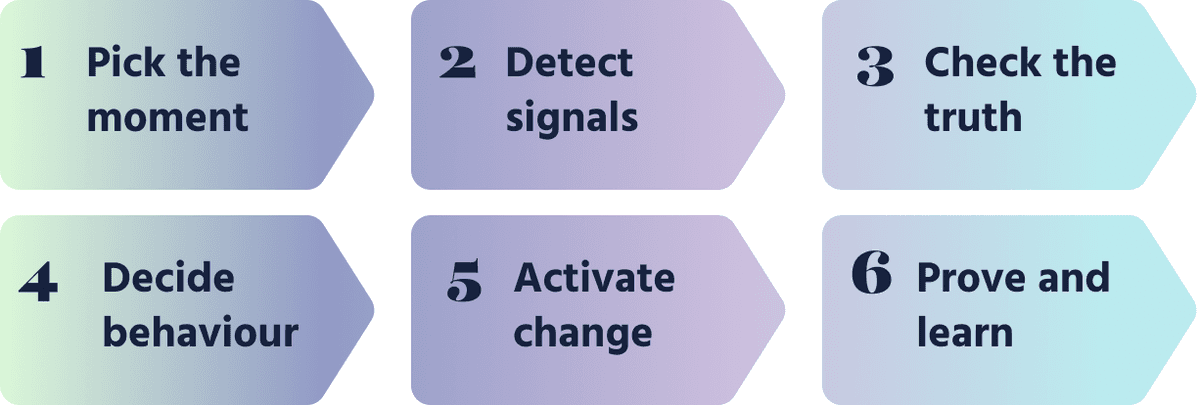
1. Pick the moment
Identify the high-value customer moment where adaptive service will make the biggest difference.
2. Detect signals
Define which real-time data points tell you what is actually happening for this customer, right now.
3. Check truth
Set confidence thresholds and evidence standards — what do you need to know before you act?
4. Decide behaviour
Map the right level of AI autonomy, channel, message, fallback, and stop rules for this moment.
5. Activate change
Build and deploy the adaptive response using your existing platforms and technology.
6. Prove & learn
Measure outcomes, feed learnings back into signal quality, and unlock higher autonomy over time.
Two ways to get started with Adaptive CX
Whether you want to run the work yourself or bring us in to lead, the Adaptive CX frameworks are the same.
Self-Serve
Buy the tools, frameworks, and card decks and run your own sessions. Everything is designed to work without a consultant in the room — structured enough to get results, flexible enough to fit your context.
Browse the toolsFacilitated Engagement
Bring Kairos in to lead the work. We run the diagnostic, design the first adaptive moment alongside your team, support the build, and leave you with artefacts you own — not a dependency on us.
Learn about engagementsPractitioners love our toolkit
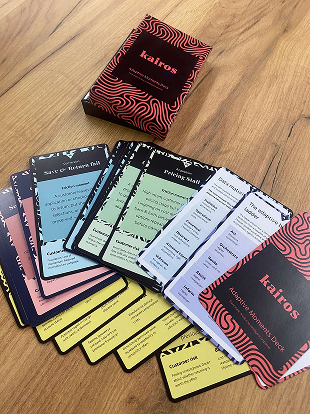
“Working with Kairos helped us reframe customer experience as something adaptive, not fixed. The card deck gave our team a practical way to spot opportunities”
Sarah Mitchell
Head of Customer Experience
“It helped us turn abstract CX conversations into something much more practical”
Jane Carter
Digital Product Head
“The framework made complex CX thinking feel tangible and usable”
Priya Shah
Service Design Lead
“It gave us a smarter way to think about customer journeys, not as static flows”
Lukas Weber
Customer Experience Director
80% fail to move beyond pilot stage — IHL Group, 2024
How can we help?
Answer 3 quick questions. We'll show you which service fits your situation.
After the quiz, you'll see:
- A recommended starting point based on your situation
- What you'll receive from that service
- What it enables you to do next
Prefer to talk?
Send us a message and we'll get back to you within 24 hours.
From fixed journeys to intelligent moments
See the difference adaptive service design makes at every stage.
Traditional CX maps assume every customer follows the same path. Adaptive CX helps services respond to changing needs, context and intent so experiences feel more relevant, reduce friction, and perform better.
Traditional CX asks
"What is the perfect journey?"
Adaptive CX asks
"What moments matter most, and how should we respond when conditions change?"
| Type | Static CX | Adaptive CX |
|---|---|---|
| Inputs | Surveys, personas, assumed preferences | Real-time signals, observed behaviour, system-of-record truth |
| Decision Logic | Fixed rules applied uniformly | Contextual response within defined boundaries |
| Cross-Channel | Separate journeys per channel | Continuous context across touchpoints |
| Governance | Review before launch, then hands-off | Continuous monitoring with escalation thresholds |
| Measurement | Aggregate satisfaction scores | Moment-level outcome tracking with feedback loops |
Why better service behaviour pays off
Static experiences leak value. Adaptive experiences recover it.
Cost-to-serve
Lower contact volume, better routing, reduced handle time
Conversion
Higher task completion, reduced drop-off, assisted conversion
Retention
Lower churn, higher renewals, improved NPS
Operational efficiency
Better routing, lower handle time, reduced repeat contacts
Speed to value
Ship using existing surfaces before rebuilding
Source: Bain and Company retention economics research
Frequently asked questions
These are the most common questions leaders ask when exploring AI in customer experience.