Stop Betting on Multi-Year AI Transformation Programmes
Why they stall and what to do instead.
There is a pattern playing out across enterprise right now.
A big AI transformation programme gets approved. It has a bold vision, a multi-year roadmap, and a serious budget. Internally, it sounds impressive.
Fast forward 18 to 36 months and the reality looks different. A few pilots. Some disconnected capabilities. Lots of architecture. Very little measurable change to customer experience.
Not because teams are not capable. Not because the technology does not work. But because the approach is fundamentally wrong.
The Uncomfortable Truth
Most AI transformation programmes do not fail because of AI.
They fail because they try to transform everything before proving anything.
They start at the wrong level. They invest in platforms before understanding the problem they are solving. They build capabilities before defining the behaviours those capabilities should enable. They commit to roadmaps before demonstrating any measurable value.
And what you end up with is what many organisations are quietly experiencing: AI theatre. Visible activity. Invisible impact. The architecture diagrams look impressive. The steering committees meet regularly. The vendor relationships are strong. But when you ask what has actually changed for customers, the room goes quiet.
Your own reality probably feels familiar. There is executive pressure to "do AI", and that pressure is real and increasing. Teams are experimenting in pockets, often with genuine enthusiasm and skill. But there is no clear definition of what success looks like, no consistent way to measure value, and no shared understanding of how these experiments connect to anything customers will actually notice.
This gap (between ambition and execution) is exactly where most programmes stall. The Activation Readiness Audit was designed to expose precisely this gap before it costs you another year and another budget cycle.
Customers Do Not Experience Transformation
Here is the core mistake. Transformation programmes assume value shows up at scale — that if you build enough capability, redesign enough architecture, and integrate enough systems, customers will eventually notice. But customers do not experience transformation. They never have.
They experience moments. A payment fails and they wonder what happens next. A delivery runs late and they check for updates that never arrive. A bill lands that does not make sense, and they spend twenty minutes trying to understand it. A subscription renewal hits their account at a price that feels too high, and they start looking for the cancellation button.
In each of these moments, the question customers are asking (consciously or not) is simple: did this service respond intelligently, or did it leave me to figure things out on my own? That is the only question that matters. And the answer has nothing to do with whether you have a transformation programme running in the background.
That is it. You do not need a transformed estate to fix that. You need better decisions in specific moments. This is the foundation of Adaptive Customer Experience — and it is what distinguishes organisations that deliver value early from those that remain perpetually in year one of their roadmap.
Why Big AI Programmes Stall: Four Predictable Failure Modes
These programmes do not fail randomly. They fail predictably — for four reasons that appear in almost every large-scale AI programme we have assessed.
1. Truth Is Not Ready
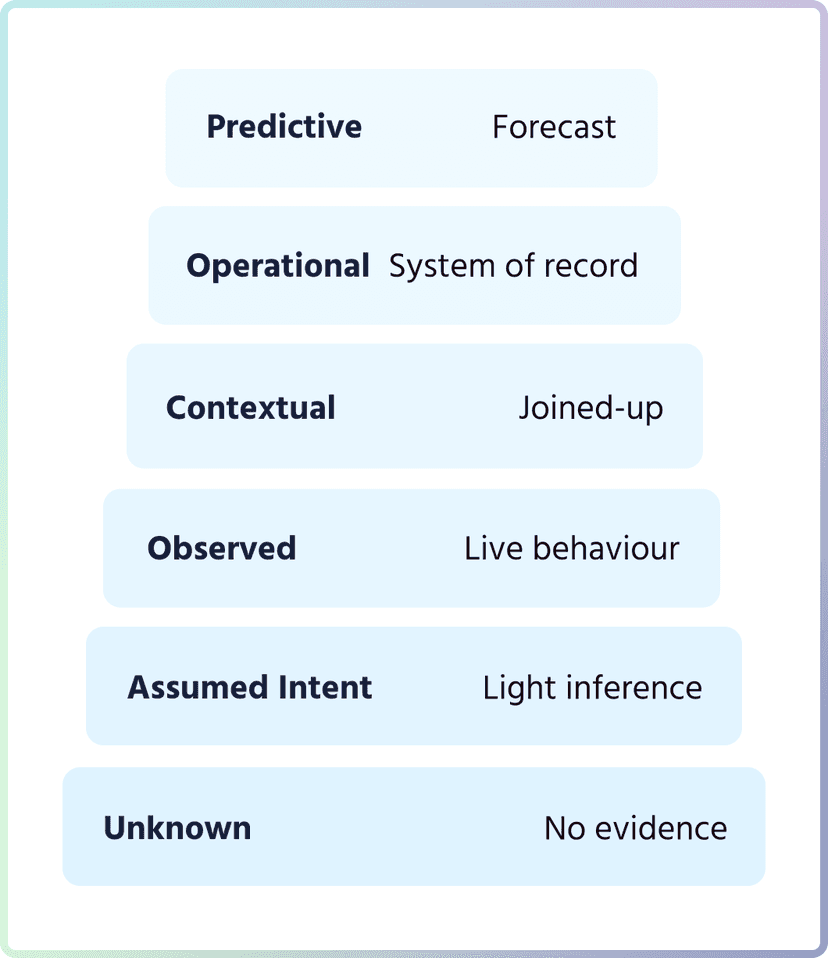
Most organisations do not actually know what is true in real time. Data exists, but it is fragmented, delayed, and conflicts across systems. When AI is introduced on top of weak or stale signals, it creates risk. Teams slow down. Or worse — they automate anyway and create confident wrongness at scale.
Signal quality is the first axis of the Adaptive CX Maturity Model. You cannot move toward autonomous behaviour until you have earned it by building reliable truth. This is not a technical problem — it is a design problem.
2. Behaviour Is Not Defined
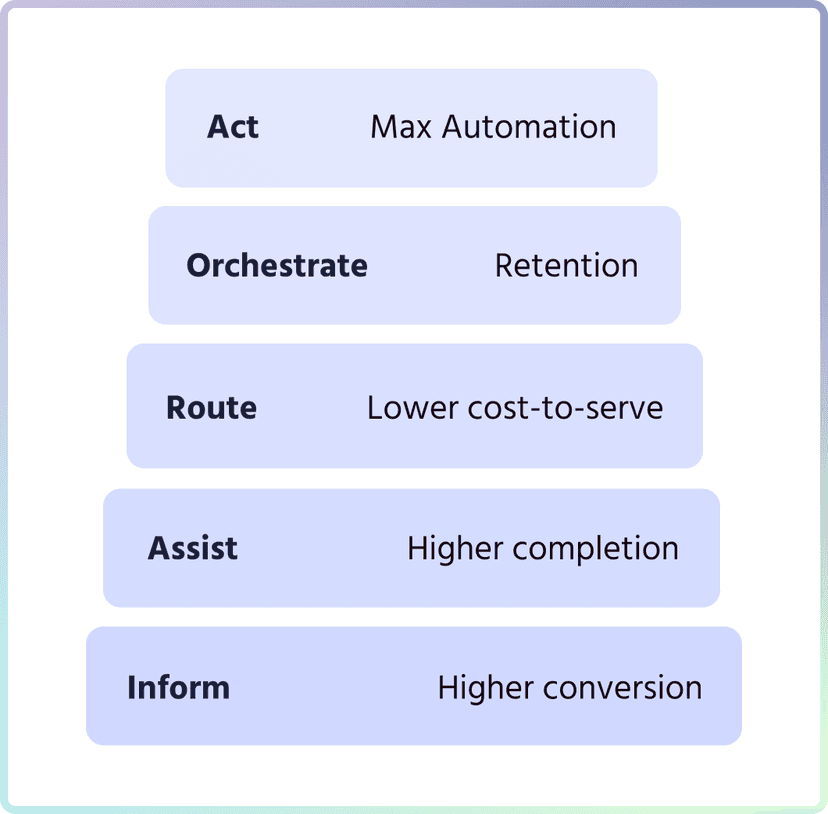
Even when data exists, teams have not answered the most important question: what should the service actually do when something happens? Not in theory, in reality. When a payment fails, should the system retry automatically? Send a message? Wait? Route to an agent? The answer depends on context, risk tolerance, and customer relationship, and most organisations have never explicitly decided.
This ambiguity is paralysing. Teams cannot confidently say what is safe to automate, what requires human intervention, and what should never happen under any circumstances. Without a clear behaviour specification, AI becomes unpredictable. And unpredictable systems do not get deployed, they get piloted indefinitely, tested cautiously, and eventually shelved. This is what the Four Gates of Safe AI Scaling address, giving teams the governance structure to define and enforce safe behaviour boundaries before activation, not after something goes wrong.
3. Activation Is Blocked
This is the failure mode most people miss. Even if you know what to do, can you actually change the experience? Can you update comms quickly? Change routing logic? Adjust agent scripts? Ship UI changes?
If the answer is "that takes months", your programme is stuck before it starts. Most organisations do not have an AI problem. They have an activation problem. Before committing to a transformation roadmap, honest organisations conduct an Activation Readiness Audit to map what they can actually change — and how quickly.
4. There Is No Proof Loop
Big programmes defer value. Year 1: strategy. Year 2: build. Year 3: rollout. But no one can confidently answer: did this reduce cost? Did this increase conversion? Did this improve retention?
So confidence drops. Budgets get questioned. Programmes quietly lose momentum. This is not a failure of ambition — it is a failure of cadence. The ROI of AI in CX should be measurable at the moment level, not aggregated across a multi-year programme.
The Shift: From Transformation to Moments
The alternative is not a smaller transformation. It is a different way of thinking entirely — one that starts with specificity rather than scale.
Instead of asking "How do we transform CX with AI?" you ask a more useful question: "Where is value leaking right now, and how should the service behave differently in that specific situation?" This reframing changes everything. Suddenly the problem becomes tractable. You are not trying to boil the ocean, you are trying to fix something real that you can actually measure.
This is the shift from static CX journeys to adaptive moments. Moments are where value is won or lost. A payment fails and the customer either recovers seamlessly or churns in frustration. A delivery runs late and the customer either feels informed and respected or abandoned and angry. These are not edge cases, they are the defining experiences that shape how customers feel about your service.
Start with a specific moment where adaptation reduces effort, prevents failure demand, or protects value. Payment failure recovery is a good example, it affects revenue directly and the behaviour is relatively straightforward to define. Delivery disruption updates work well because the signals are often available and customers have clear expectations. Cancellation intent handling is high-stakes but high-reward. Billing clarity at renewal prevents the kind of confusion that drives unnecessary contact volume. Abandoned cart intervention is measurable within days. Each of these moments is visible, measurable, and fixable, independently of whatever else is happening in your wider transformation programme.
Use Maturity to Decide What Is Possible
This is where most AI strategies become unrealistic. They jump straight to automation, personalisation, and agentic behaviour, seduced by vendor demos and competitor announcements, without asking whether they actually have the truth required to do any of this safely. The result is predictable: ambitious pilots that cannot scale, autonomous systems that make confident mistakes, and a growing gap between what was promised and what gets delivered.
The Adaptive CX Maturity Model provides a more honest frame. Two axes define what is actually achievable. The horizontal axis measures signal quality: how reliable, real-time, and complete is the truth you are acting on? The vertical axis measures behaviour autonomy: how independently does the service act on that truth? The relationship between these axes is not arbitrary. You cannot safely move toward more autonomous behaviour unless you have earned that right by building stronger truth.
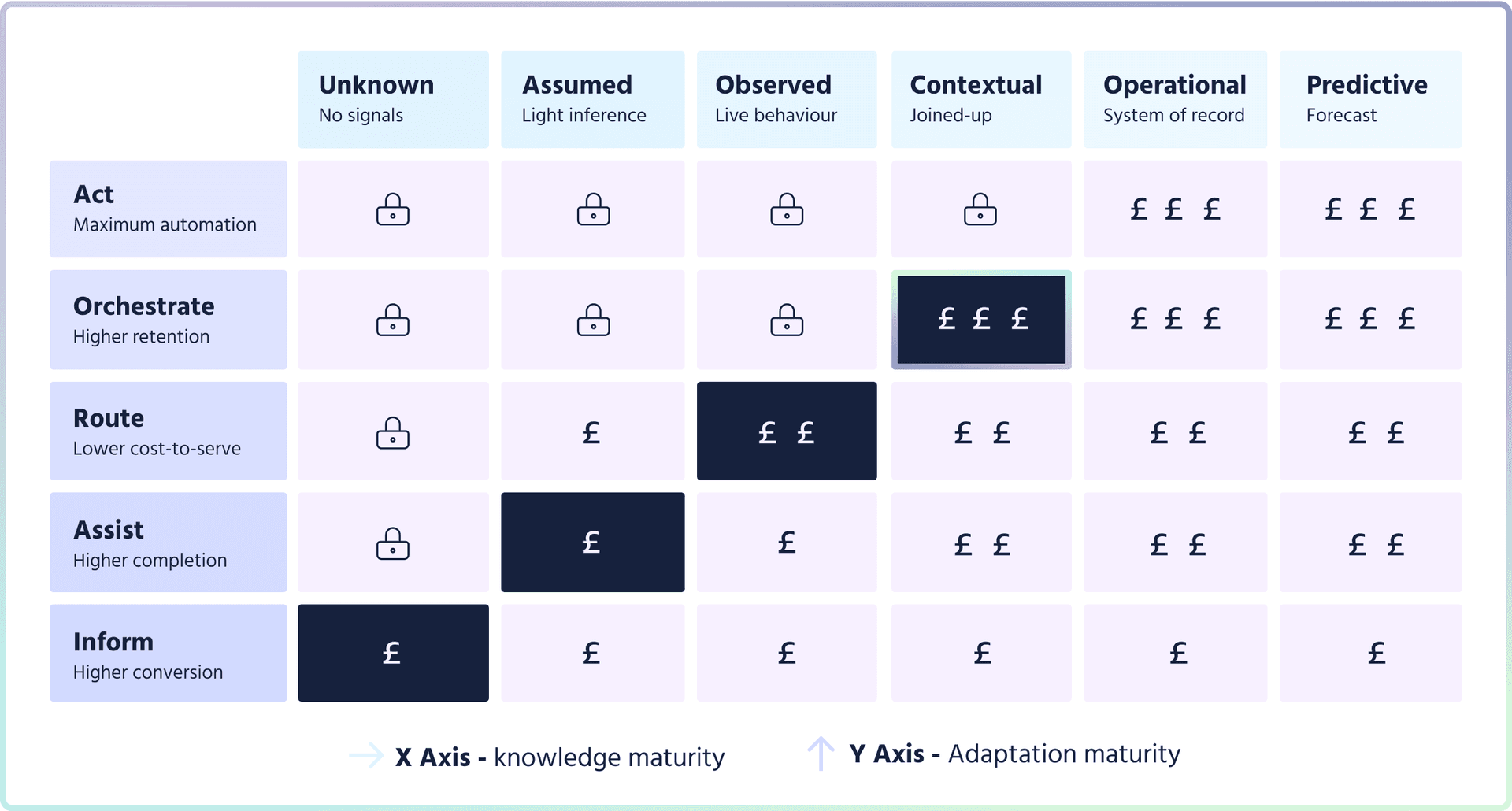
This creates a natural progression. When signals are weak or delayed, the appropriate behaviour is to inform and assist — surfacing what you know to humans who can decide. As signal quality improves and confidence grows, you can route and orchestrate — making decisions about where work should go and when. Only when systems are proven, governance is strong, and truth is reliable should you consider acting autonomously on behalf of customers.
This discipline is how you avoid scaling the wrong thing. It is also why agentic AI should only appear late in your maturity progression, not as an early ambition that outpaces your actual capability to deliver it safely.
Deliver Value Iteratively, Not Theoretically
Transformation programmes optimise for certainty before action. They want to know the full architecture before building anything. They want executive alignment before running experiments. They want the complete roadmap before shipping the first improvement. This feels responsible, but it is actually a form of avoidance, a way of deferring the discomfort of learning in production.
The moment-led approach optimises for learning through action. You pick a high-value moment, identify the signals that indicate it is happening, verify what is actually true in real time, define what safe behaviour looks like, ship using whatever surfaces are already available, measure the impact, and then improve. This is not reckless, it is disciplined. Each step is bounded, reversible, and measurable.
This is the operating cadence described in the Adaptive CX framework, a repeatable loop that compounds learning and value over time. Each iteration does not just fix one moment. It builds better signals that inform the next decision. It strengthens governance and institutional confidence. It unlocks new capabilities that were previously out of reach. And it increases organisational confidence to act more autonomously in the future.
Why This Works: Typical Outcomes
The reason this approach works is simple: value shows up early. Not in year three when the transformation programme finally reaches rollout. Not in some future state when all the pieces are in place. In weeks. Sometimes days.
Organisations taking a moment-led approach typically see reductions in avoidable contacts of between ten and twenty-five percent, often within the first quarter. Conversion improvements at high-friction moments run between five and fifteen percent, which compounds significantly across volume. Retention gains at cancellation and renewal moments can be dramatic, because these are precisely the moments where intelligent intervention makes the biggest difference. And time to value collapses: from two or three years for large programmes down to three to six months for targeted improvements.
But the numbers are only part of the story. What really changes is confidence. When teams can point to real outcomes, not projections, not models, not pilot results that "show promise", they earn the mandate to expand. Investment becomes easier to justify because it is no longer speculative. The next moment becomes easier to prioritise because you have evidence that this approach works. Confidence compounds alongside value.
This Is Just Modern Change Done Properly
What is interesting is that this is not new thinking. It is just applying proven principles properly — principles that most AI programmes ignore.
Lean: focus on real problems, eliminate failure demand, prove value quickly before scaling.
Agile: deliver in short cycles, adapt based on evidence, avoid overbuilding ahead of proof.
Test-and-learn: treat each moment as a hypothesis, measure before scaling, build evidence not opinion.
The reason multi-year AI programmes feel heavy, slow, and disconnected from outcomes is that they violate all three. They build confidence on paper before proving it in production. The human-AI partnership that delivers real results operates on a much shorter cadence, with clear boundaries, defined escalation paths, and measurable outcomes at every stage.
The Real Shift: From Transformation to Compounding Value
There is no finish line for customer experience. The idea that you will one day "complete" your transformation and move on to something else is a fantasy. Customer expectations evolve. Competitive dynamics shift. Technology capabilities expand. The organisations that win are not the ones that finish first, they are the ones that improve fastest.
This reframes the question entirely. Instead of asking "When will we be transformed?" you ask "How quickly can we improve the next moment?" That question has a concrete answer. It can be measured. It can be optimised. And most importantly, it compounds.
Each improvement builds better signals for the next decision, you learn what data matters and how to access it faster. Each improvement strengthens governance and institutional confidence, you develop clearer boundaries and faster decision-making. Each improvement unlocks new capabilities that were previously out of reach, the second moment is easier than the first, and the tenth is easier than the second. This is how adaptive organisations actually scale: not through big bets that pay off years later, but through compounding decisions that accumulate advantage over time.
From Theory to Practice: A Real Example
Let me make this concrete with an example. A head of customer experience at a mid-sized insurance company came to us with a familiar frustration: they had invested significantly in a CX platform and AI chatbot. Both were well-implemented. Both had been given reasonable time to prove themselves. But the needle had barely moved on customer satisfaction, and escalations to human agents were stuck at forty percent for complex queries.
Their leadership was pressuring them to expand the platform, more AI, more automation, more sophistication. The vendor was offering a more advanced roadmap. The case studies from competitors looked impressive. The natural move was to commit to a multi-year programme to "get AI right."
Instead, they asked a different question: where exactly is the frustration most acute? Through conversation, they identified a specific moment: policy renewal. Customers would start the renewal journey, encounter questions they did not understand about coverage options, then either abandon the process or escalate to an agent. This moment was affecting their top line directly, lower completion rates, higher contact centre volume, worse net promoter scores at a high-value moment.
They already had the data. They already had the platform. What they did not have was a clear definition of what the service should actually do at the moment a customer got stuck. Should it clarify the question? Route them to an agent? Suggest the most common choice? Offer to call them? The answer depended on risk tolerance, service philosophy, and business value, and nobody had actually decided.
Once they defined that behaviour (detect confusion, offer live clarification from a specialist agent, remember the context for future renewals) the implementation took two weeks. The system was not new. The data was not better. What changed was clarity: a specific moment, a clear signal, a defined behaviour, and a way to measure it.
The result: completion rates on renewal jumped by eighteen percent in the first quarter. Escalations for that moment dropped by a third. And they had a documented example of what adaptive behaviour actually looks like, something they could then replicate in four other high-friction moments within twelve months. That is not a transformation programme. That is compounding value through disciplined iteration.
Assess Your Readiness: Four Key Questions
Before you pick your first moment, it is worth asking yourself whether you are actually ready to improve it. Not ready from a capability perspective, most organisations have more capability than they think, but ready from a clarity and commitment perspective. Here are four questions that separate organisations that move fast from those that remain stuck in planning.
1. Can You Name the Moment?
Not strategically. Not as a category. As a specific moment. "Payment failure recovery." "Delivery disruption notification." "Cancellation intent at renewal." "Abandoned cart intervention within fifteen minutes of departure." If you cannot name it with enough specificity that someone unfamiliar with your business could visualise it, you are not ready yet. Go back and talk to customers until you can be specific. The moment has to be vivid enough that you can describe the exact sequence of events, the signals you would see, and the behaviour that would change the outcome.
2. Do You Know What the Current Behaviour Is?
What does the service do right now when this moment happens? Often the answer is: "Nothing obvious" or "Whatever the system defaults to." But there is a current behaviour — even if it is neglect. You need to understand it in detail. What does the customer experience? What signals does the system have access to? Where do things go wrong? The goal is not to judge the current state — it is to see it clearly. Many organisations have skipped this step and proposed solutions to problems they did not actually understand. Spend time in production. Look at real conversations. Follow the data. See what actually happens versus what you assumed happened.
3. Do You Have a Clear Signal That the Moment Is Happening?
This is where most initiatives stall. You need to reliably detect that this moment is occurring in real time, not in a report next week, but as it is happening. Sometimes this is easy. "Customer clicking the 'Cancel Subscription' button" is a clear signal. Sometimes it requires work. "Customer is about to abandon their cart" requires inference from browsing patterns, time spent, mouse movement. Sometimes the signal is noisy, multiple things look like one moment, or one moment looks like multiple things. If you do not have a clear, reliable signal, the behaviour you define will be guessing. You will activate it for the wrong customers or miss it entirely for the right ones. So ask directly: if we wanted to detect this moment happening right now, what data would we need? Do we have it? Is it reliable? If the answer is "sort of" or "we could get it but it would take months," that is useful information. It might not be your first moment. Choose a moment where you already have strong signals.
4. Do You Know What Safe Behaviour Looks Like?
This is the question that kills a lot of initiatives quietly. You have identified a moment. You can detect it. But what should the system actually do? "Improve the experience" is not an answer. "Be smarter" is not an answer. You need to define behaviour with specificity: retry this payment method twice with these intervals, then route to a human; send this notification with this message at this time; offer these three options in this priority order; route to a specialist with this skill set. The behaviour has to be testable. It has to have guardrails. It has to fail safely.
Many organisations skip this because it feels like premature detail, and then they end up activating systems that behave unpredictably and lose the trust they were trying to build. The Four Gates of Safe AI Scaling framework helps here. It forces you to define exactly what "safe" means before you activate anything. Use that discipline. It is not bureaucratic overhead, it is the precondition for moving fast with confidence.
The Readiness Checklist
If you can answer yes to all four questions above, you are ready to start. You do not need perfect answers, just honest ones. You do not need months of preparation, just enough clarity that your team can move. Here is what that checklist looks like in practice:
- Moment is specific. Someone unfamiliar with your business can visualise it.
- Current behaviour is documented. You have seen it in data and in customer feedback.
- Signal is available and reliable. You can detect this moment happening with reasonable confidence.
- Safe behaviour is defined. You have written down what the service should do, with explicit guardrails.
- Success is measurable. You can define a metric that will tell you if this worked: completion rate, escalation rate, time to resolution, revenue impact, whatever is most relevant.
- The team has capacity. Not everyone. Just enough people to design, build, and iterate on this one thing over the next quarter.
If you have these six things in place, you do not need more clarity. You need to ship. Get it in front of real customers. Measure what happens. Iterate. Build the institutional muscle of improving moments faster than your competitors can.
Where to Start
Most organisations reading this already have a moment in mind — a place where value is leaking, where customer frustration is predictable, where the fix is knowable but keeps getting deprioritised in favour of the bigger programme.
Start there.
Not with a platform decision. Not with a governance framework. Not with a new roadmap. With a single moment, a clear signal, a defined behaviour, and a measurable outcome.
If you want a structured way to identify that moment and assess your readiness to act on it, the Kairos diagnostic is the right starting point. We assess your signal quality, your activation surfaces, and your current maturity — and give you a prioritised view of where moment-led value is most accessible right now.
Start small. Prove value. Scale with discipline. That is not a consolation prize for organisations that could not afford the big programme. It is the only approach that reliably works.