Adaptation Hierarchy
This is how you avoid the classic move: jumping straight to "autonomous AI" before you can trust your truth. Progress maturity with intent: Inform → Advise → Assist → Act, with human handover baked in.
What is the adaptation hierarchy?
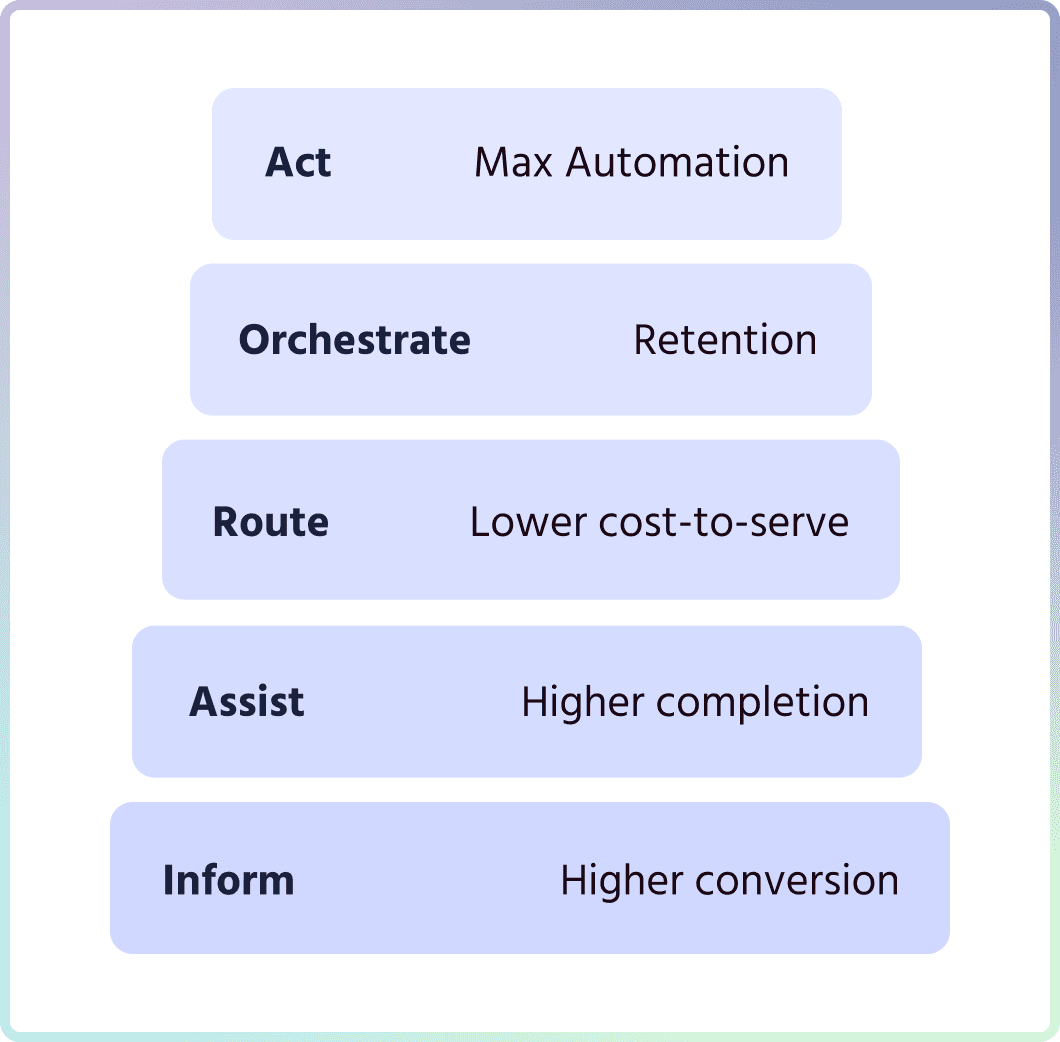
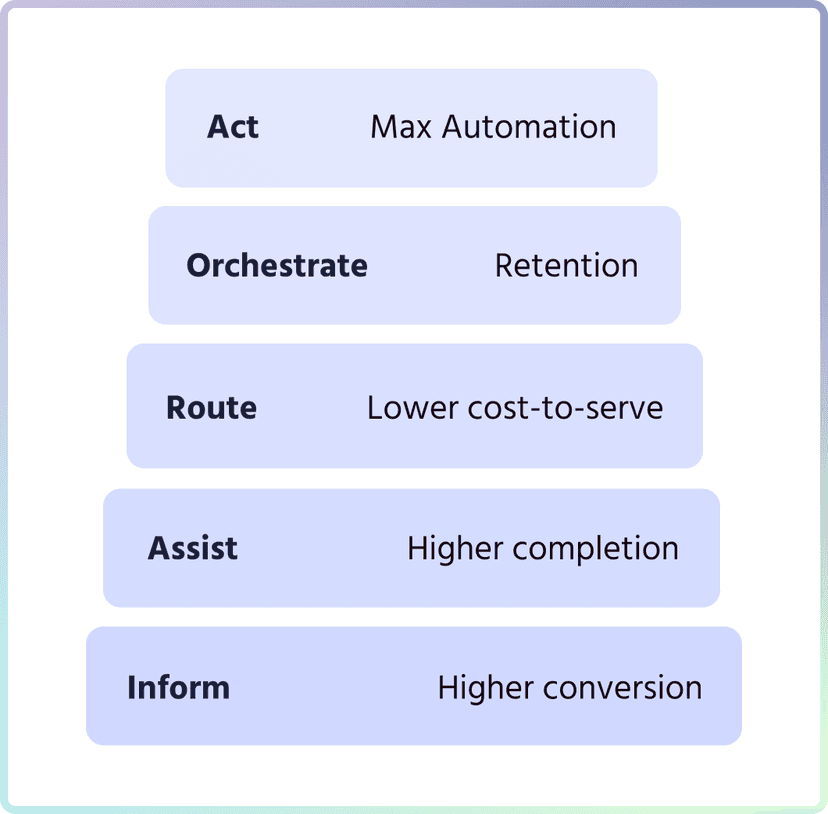
The adaptation hierarchy defines how much autonomy a service has in a given moment. At the lowest level — Inform — the service personalises what the customer sees but makes no decisions on their behalf. At the highest level — Act — the service executes changes without waiting for confirmation. Between these extremes sit Assist, Route and Orchestrate, each representing a step up in service autonomy and a corresponding increase in the quality of signals and truth required.
The hierarchy exists because jumping to full automation is dangerous when your truth maturity does not match your ambition. An AI agent that reschedules deliveries based on estimated arrival windows is not being helpful — it is guessing with consequences. The adaptation hierarchy forces a deliberate progression: prove that your signals are reliable and your governance gates hold at each level before moving to the next. This is how organisations scale adaptive CX without scaling risk.
Activation Surfaces
| Surface | Examples | Lead Time | Owner |
|---|---|---|---|
| Comms Templates | Email, SMS, push notifications | 1-2 weeks | Marketing/CRM team |
| Routing Rules | IVR flows, chat assignment, case queues | 1-3 weeks | Contact center ops |
| Workflows | Agent scripts, macros, knowledge articles | 1-2 weeks | Support operations |
| UI Modules | Banners, cards, modals, forms | 2-6 weeks | Product/Digital team |
| Platform Rules | Segment logic, content decisioning, personalization | 2-4 weeks | Martech/Platform team |
| API/Integration | Order management, CRM, carrier tracking | 4-12 weeks | Engineering |
The critical insight is that you don't need a platform overhaul to start. Most organizations already have activation surfaces they're not fully utilizing. Comms templates can deliver proactive disruption updates. Routing rules can send customers to the right team with context. Agent scripts can provide consistent guidance based on moment detection.
Activation Readiness is the practice of mapping what surfaces exist, who owns them, what lead times apply, and what changes are blocked. This prevents "AI theatre"—impressive strategy decks that can't be activated because nobody can actually change anything.
When you discover activation is blocked, you have three options:
- •Use low-tech levers first — Deliver value through comms, routing, and scripts while platform work happens
- •Prepare activation capability — Invest in unlocking faster surfaces (e.g., content management, rules engines)
- •Defer high-Y moments — Choose moments that match your current activation capability
The worst mistake is designing Y5 (Act) moments when your activation reality is "we can change email templates every two weeks." Match ambition to capability, then systematically unlock higher surfaces.
Matching autonomy to activation capability
There is a direct relationship between what you want the service to do and what your platforms can actually deliver. Designing an "Orchestrate" behaviour — coordinating across chat, email and in-app notifications in real time — requires activation surfaces that support cross-channel triggering and shared context. If your current reality is siloed platforms with manual handoffs, you have a gap between ambition and activation capability.
The adaptation hierarchy makes this gap visible rather than hiding it in strategy decks. When you map each behaviour spec to the activation surfaces it depends on, you immediately see which moments are deliverable today, which require platform investment, and which should be deferred until activation readiness improves. This prevents the most common failure in AI CX programmes: designing moments that are technically impressive but operationally impossible.
What we can change as the tech progresses
How to choose the right level
Choose based on:
Risk of wrong
Customer harm, cost, trust
Truth reliability
Confidence + freshness
Reversibility
Can we undo it easily?
Need for consent
Must the customer confirm?
Operational readiness
Can humans take over cleanly?
The diagonal rule: why knowledge must lead adaptation
The CX maturity model follows a diagonal principle: knowledge maturity (the X-axis) must exceed adaptation maturity (the Y-axis) for any moment to be safe. You cannot safely route customers to specialised teams (Y3) if your only signals are form submissions and basic profile data (X1). You cannot automatically execute refunds (Y5) if your understanding of the customer's situation comes from estimated timelines rather than verified operational truth (X4).
This diagonal rule is what prevents "confident wrongness at scale" — the pattern where organisations automate high-consequence actions based on behavioural guesses rather than operational facts. Every step up the Y-axis should be preceded by a corresponding step along the X-axis. If your truth maturity is at X2 (observed behaviour), your safest adaptation level is Y2 (Assist). Attempting Y4 (Orchestrate) at X2 means coordinating across channels based on assumptions — and the failures compound with every channel involved.
Understanding this relationship changes investment priorities. If you are at X1 but want Y3 outcomes, the answer is not to push harder on routing logic. It is to invest in signal quality and truth contracts until your knowledge maturity supports the adaptation level you are targeting.
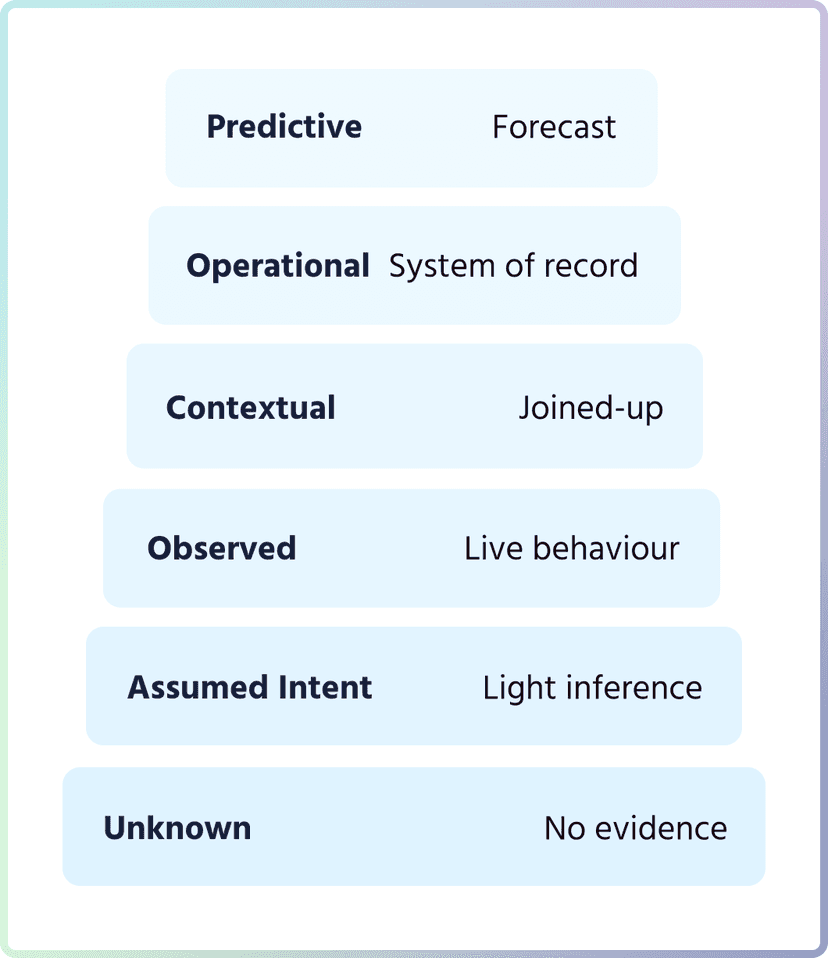
What data we have available (X-axis)
What we can change as tech progresses (Y-axis)
The CX Maturity Model
This framework is the control plane for adaptive CX. It governs what you design, when you design it, and how you scale safely. At its core are two dimensions that determine both capability and value.
The horizontal axis represents knowledge maturity, labeled X. It measures how reliable your truth is, progressing from X0 (no signals, only guesses) through X5 (predictive signals with drift monitoring). The vertical axis represents adaptation maturity, labeled Y. It measures how dynamically your service responds, progressing from Y1 (inform with static content) through Y5 (act by executing changes on behalf of customers).
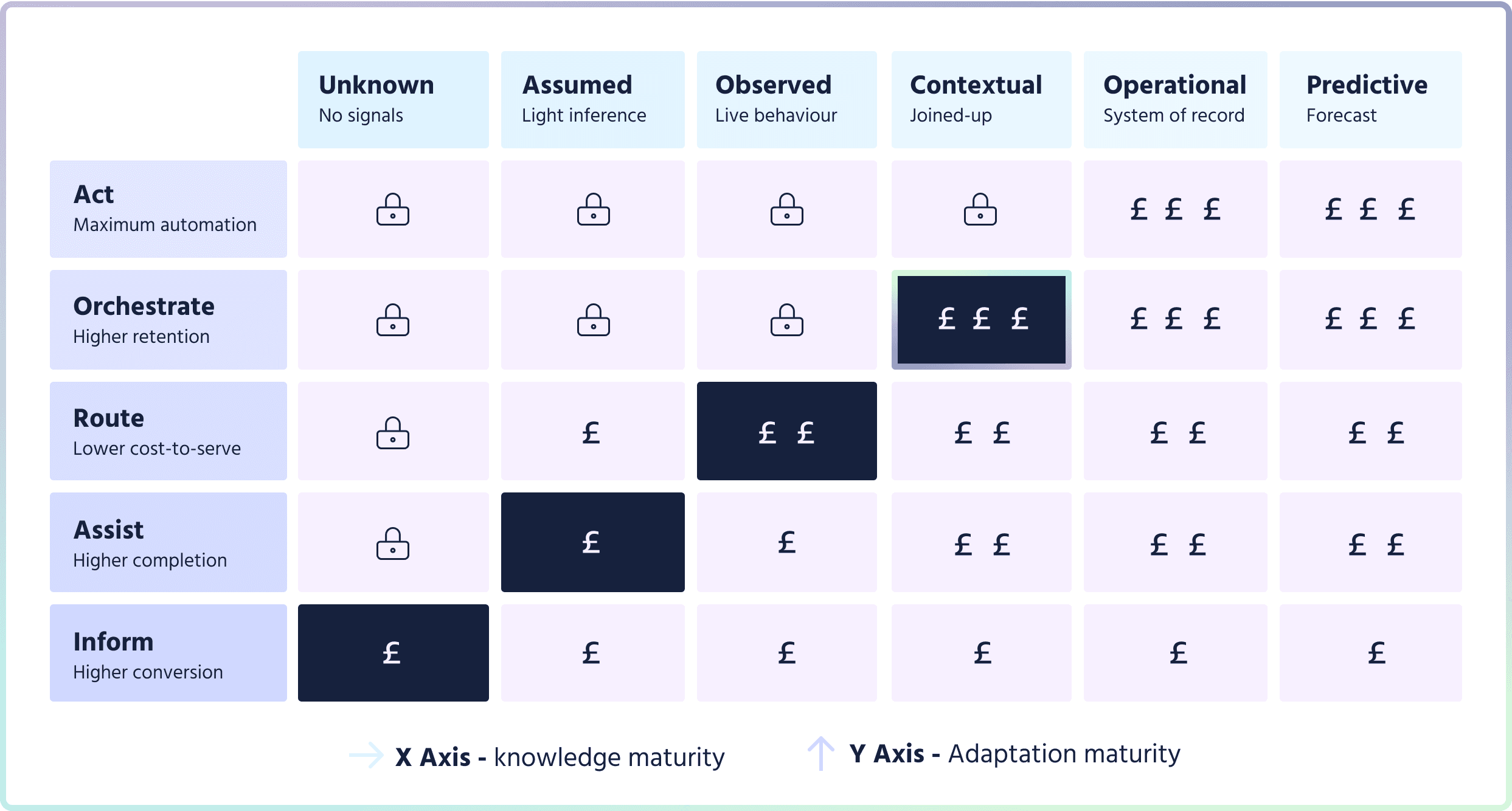
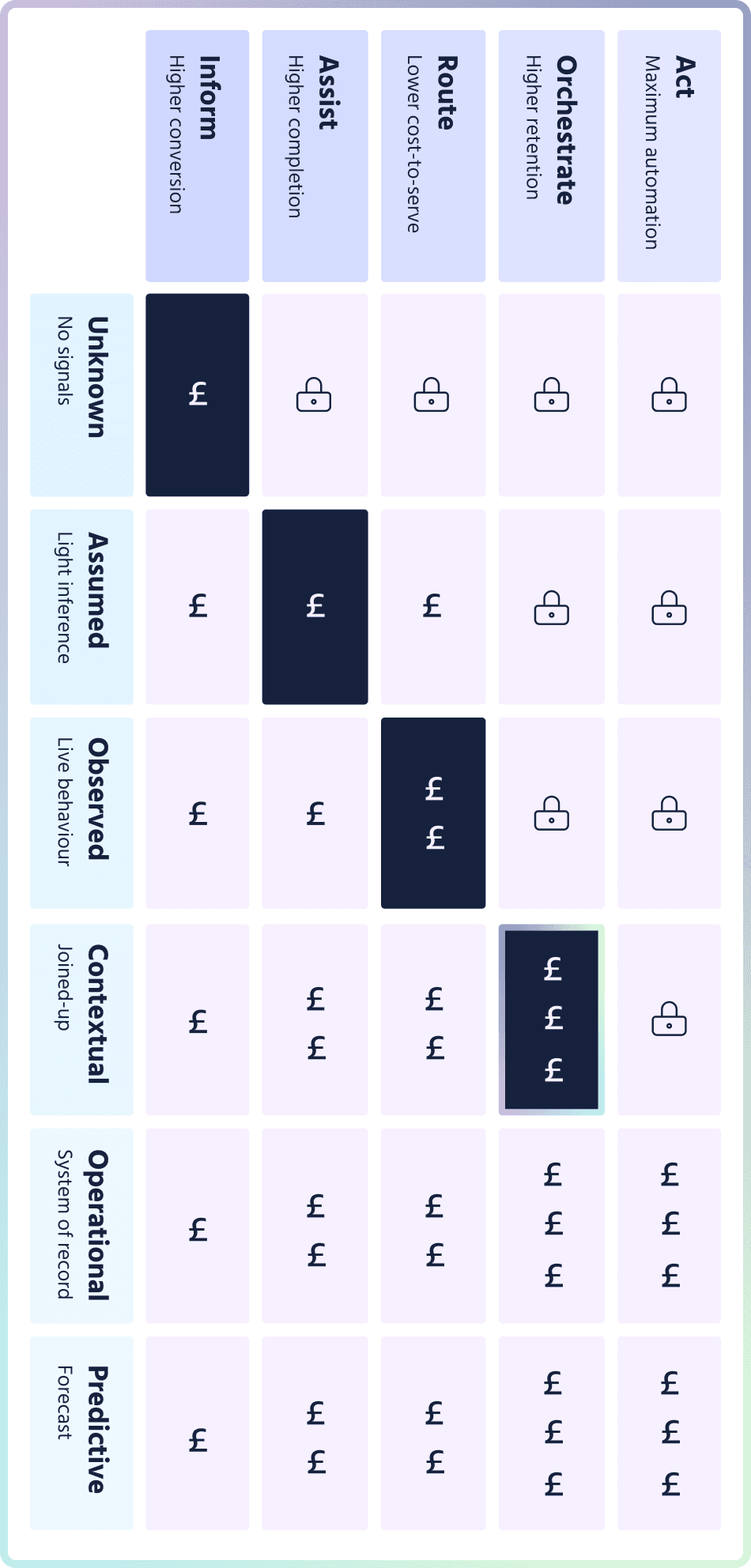
The relationship between these dimensions follows a diagonal rule. Higher Y capabilities require stronger X foundations. You can't safely route customers based on behavioral signals alone (Y3) if your only signals are form submissions (X1). You can't automatically reschedule deliveries (Y5) if you're working with estimated ETAs rather than operational truth from systems of record (X4).
Most organizations begin at X1-X2 with Y1-Y2. They use declared preferences and observed behaviors to inform customers and assist with simple tasks. This is achievable and low-risk, but also low-value. The high-value opportunities emerge at X3-X4 with Y3-Y4, where contextual and operational truth enables intelligent routing and cross-channel orchestration.
The grid makes one thing clear: you must strengthen the X-axis before you can safely move up the Y-axis. Organizations that jump to Y5 (act) while still at X2 (observed) are designing confident wrongness at scale. They're automating actions based on behavioral guesses rather than operational truth.
Understanding where you are on this grid determines your investment priorities. If you're at X1, invest in signal quality and operational truth before attempting orchestration. If you're at X4 but only Y2, you have dormant value waiting to be unlocked through higher adaptation.
Common pitfalls
- Acting with uncertain truth ("we think it's delayed" → auto compensation)
- No graceful escalation (customer gets stuck in loops)
- Measuring the wrong thing (CSAT only, not moment outcomes)
- Treating "Act" as the goal, not the tool